AI compute cost

AI Inference Cost Decisions

Use these pages when an AI app is moving from prototype to production and the real question is what inference will cost per request, per month, and per completed workload.

By Andrew Cooper, Founder of RunPlacement Updated May 2026 Provider-neutral, estimate-labeled guidance Verify current provider pricing

Direct answer

How to compare AI inference cost

AI inference cost should be modeled by effective cost per successful request, monthly serving cost, latency, utilization, and operational burden.

Best starting page: AI Inference Cost Model

Start here if

Route yourself to the right page

This hub is a cluster map, not just a list. Use the matching page first, then follow the internal links.

Use this cluster when

  • An AI app is leaving prototype usage and cost is becoming a margin issue.
  • You are comparing API, managed inference, self-hosted GPU, batch, or hybrid serving.
  • The team needs to explain why token price or GPU hourly rate is not the whole cost.

Common mistakes

  • Comparing token price directly to GPU hourly rate.
  • Ignoring idle serving capacity.
  • Treating every model call as realtime.
  • Leaving engineer time out of self-hosting math.

Questions answered

Top questions in this cluster

These are the concrete questions the pages below are built to answer.

How do I estimate AI inference cost?
When is API cheaper than self-hosted inference?
Should this workload use batch or realtime inference?
Is managed inference worth the platform premium?

Interactive tool

Estimate API vs managed vs GPU inference cost

Use the calculator once the checklist has request volume, output size, retry rate, serving mode, warm hours, utilization, and ops ownership filled in.

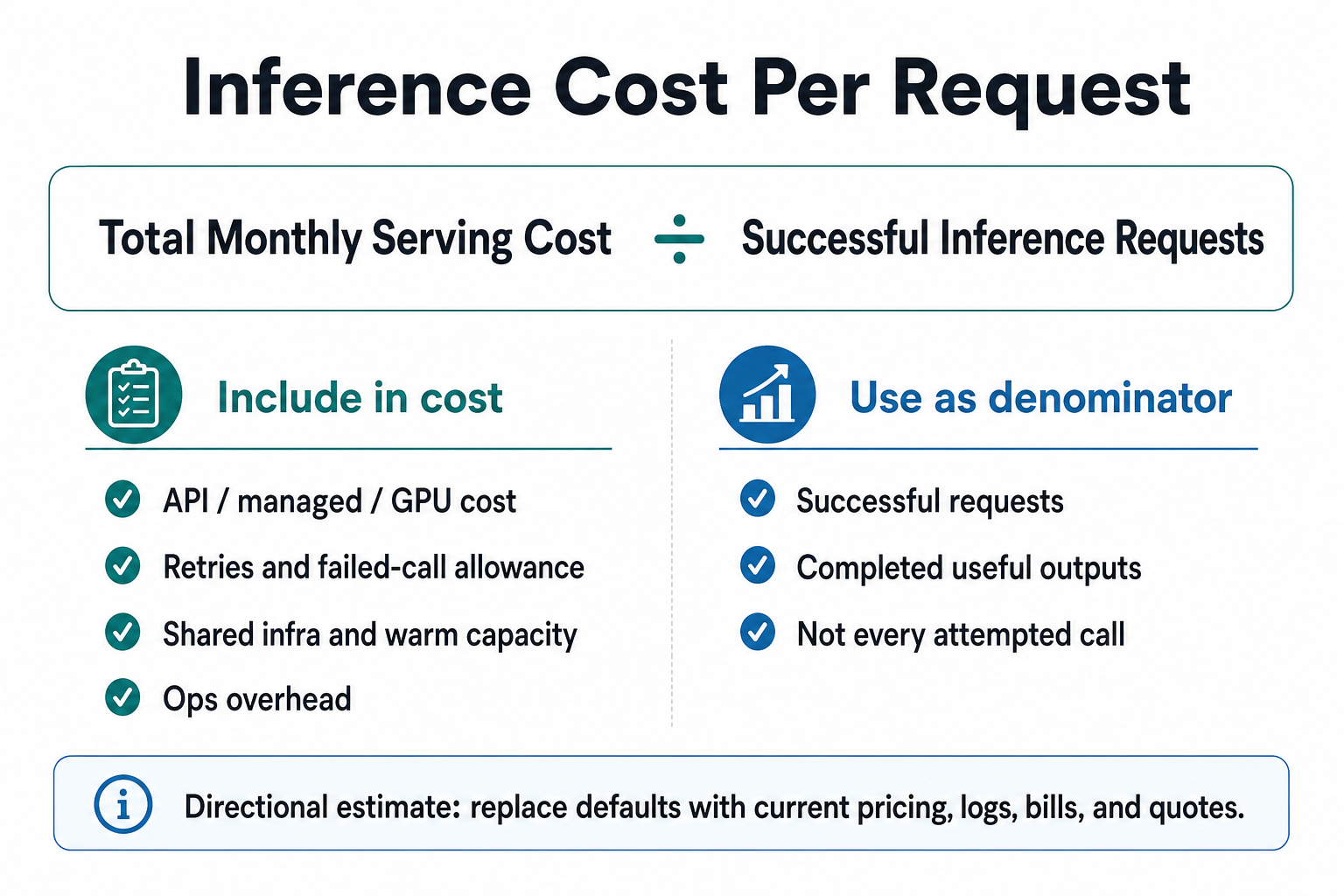
Defaults are hypothetical; replace them with current provider pricing, logs, bills, and quotes.
Open calculator

Worksheet asset

Capture the fields before comparing providers

The checklist is the shareable companion to the calculator and formula infographic: it keeps the assumptions visible before a team debates API, managed inference, or self-hosted GPU.

Start here

Start with your situation

Pick the situation closest to what is happening right now. Each path leads to a calculator, worksheet, or decision page with the next useful step.

Sample output

Sample AI Compute Cost Read

Hypothetical production realtime LLM feature. This is the kind of directional read the calculator and worksheet are designed to produce, not a quote or benchmark.

Directional read

API may still be simplest until usage is less uncertain.

Managed or self-hosted serving only becomes plausible after volume, utilization, latency, and operations ownership are clearer.

Sensitive variables

  • Request volume and peak-to-average traffic.
  • Output size, retries, and failed calls.
  • Warm hours, useful utilization, and ops overhead.

Missing assumptions

  • Current provider pricing and API invoice data.
  • Latency target, real logs, failure rate, and quote terms.
  • Who owns deploys, monitoring, rollback, and incidents.

Next data to collect

  • 7-day request sample and p95 output size.
  • Retry/timeouts, managed serving quote, and GPU quote.
  • Ops owner and minimum reliability requirement.

Start here

Use the cluster in this order

  1. Open the AI inference cost model.
  2. Compare API versus self-hosted inference only after traffic shape is clear.
  3. Use the inference checklist before committing to GPUs or managed serving.

Common confusion

API token price can look simple while margins disappear at volume.
Self-hosted GPU can look cheap while idle capacity, storage, networking, and engineering time dominate.
Batch inference and realtime inference need different cost models.

Decision pages

Start with the closest problem

These pages answer the specific questions inside this topic cluster.

AI inference costAPI vs Self-Hosted Inference: Which Costs Less?Commercial comparison

API inference usually wins for uncertain or low-volume workloads; self-hosted inference can win when volume, utilization, latency, or control needs justify GPU operations.

AI inference costBatch vs Realtime Inference Cost: How to ChooseCost estimation

Batch inference is often cheaper when latency is flexible because work can be queued for higher utilization; realtime inference costs more when warm capacity and strict latency are required.

AI inference costManaged Inference vs GPU Cloud: Cost and Control TradeoffsCommercial comparison

Managed inference can cost more on paper but win when autoscaling, batching, reliability, and lower ops burden reduce effective inference cost.

AI inference costSelf-Hosted LLM Inference Cost: What to IncludeCost estimation

The GPU hourly rate is only the starting point for self-hosted LLM inference cost; warm capacity, utilization, storage, networking, monitoring, reliability, upgrades, and team time all belong in the estimate.

AI inference costLLM API Bill Too High? What to Check FirstCost triage

A high LLM API bill is usually a triage problem first: check whether output size, retries, tool calls, caching gaps, routing, or batchable work are driving the increase.

AI inference costInference Cost Per Request: Simple FormulaFormula

A useful inference cost per request starts with total monthly serving cost divided by successful inference requests, with failed calls and retries handled explicitly.

AI inference costGPU Utilization for Inference: Why Useful Hours MatterCost explanation

GPU utilization matters for inference because paid warm capacity can sit idle between requests, peaks, batches, deploys, or failures.

AI inference costSelf-Hosted Inference Break-Even: Directional FrameworkBreak-even framework

Self-hosted inference reaches break-even only when optimized API or managed cost is higher than fully loaded GPU serving cost at realistic utilization.

AI inference costBatch Inference Cost Savings: When Queueing HelpsCost optimization

Batch inference can reduce cost when the work can wait, queueing raises utilization, and the system avoids always-warm realtime capacity.

Frameworks

Define the concepts behind the answers

These pages give readers the definitions, formulas, and decision tables behind the cluster.

Capacity decisionsGPU Utilization Break-Even: When A Cheap GPU Cloud Actually Saves Moneycost_breakdown

A practical GPU utilization break-even page for deciding when lower hourly rates outweigh idle time, retries, and operational overhead.

Capacity decisionsGPU Training Cost Breakdown: Before You Rent The Biggest GPUcost_breakdown

A practical breakdown of GPU training cost drivers, including runtime, checkpointing, failed runs, storage, data movement, and capacity planning.

Cost breakdownsGPU Cloud Hidden Fees: The Costs Missing From The Hourly GPU Ratecost_breakdown

A checklist of GPU cloud costs that are easy to miss, including storage, bandwidth, idle time, retries, support, and commitment waste.

Cost breakdownsGPU Cloud Pricing Checklist: What the Hourly Rate Leaves Outcost_breakdown

A checklist for comparing GPU cloud quotes beyond the hourly GPU price, including storage, bandwidth, idle time, availability, and ops.

Resources

Useful checklists

Worksheets that make this topic easier to compare with real request volume, bill lines, quotes, or workload notes.

AI inference cost quiz

Get an AI compute cost read

Estimate effective inference cost before choosing API, managed inference, self-hosted GPU, or batch processing.

Uses actual request volume, latency, GPU need, data movement, priority, and ops tolerance.
Start the AI compute read