AI inference cost / RunPlacement framework
AI Inference Cost Model
Direct answer: AI inference cost should be compared as effective cost per successful request and monthly serving cost, not just token price or GPU hourly rate.
- Use APIs when usage is uncertain or ops tolerance is low; consider managed or self-hosted GPUs when volume, latency, data control, or model requirements justify the overhead.
- Use provider pricing pages and your own bill or quote before making a purchase or migration decision.
Next action
Use the formula
Start with total monthly serving cost divided by successful requests. Then compare API, managed inference, and self-hosted GPU only after idle capacity and operations are included.
Open calculatorDefinition
AI inference cost
AI inference cost is the total cost of serving model outputs, including token/API charges or GPU time plus idle capacity, storage, networking, observability, reliability, and engineering overhead.
Effective inference cost = total monthly serving cost / successful inference requests.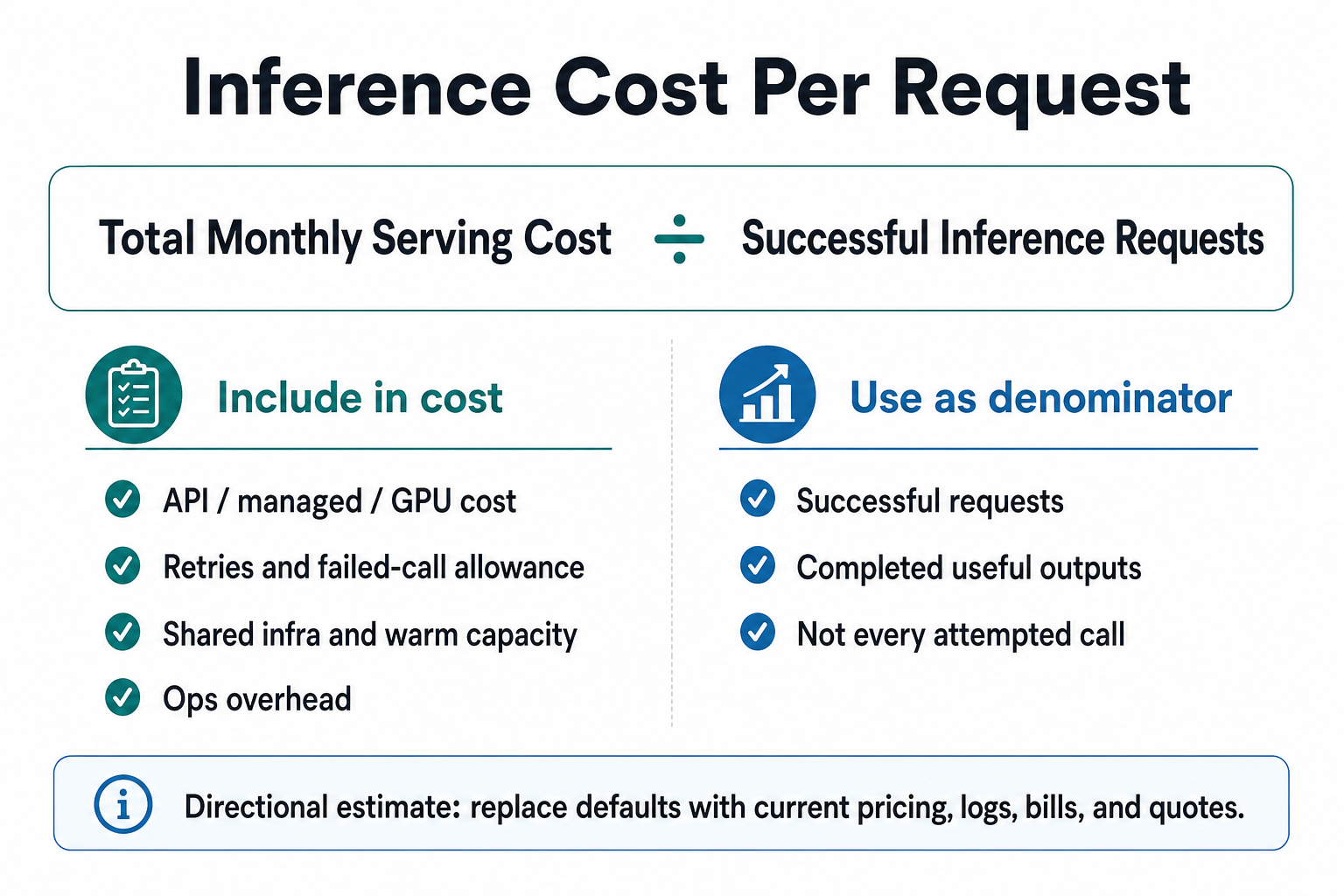
Key idea
How to use the formula
AI inference cost should be compared as effective cost per successful request and monthly serving cost, not just token price or GPU hourly rate.
Use APIs when usage is uncertain or ops tolerance is low; consider managed or self-hosted GPUs when volume, latency, data control, or model requirements justify the overhead.Example scenarios
An API can be the right starting point because there is no idle GPU baseline to carry.
Batch jobs can justify GPU or managed batch serving when utilization is high and latency is flexible.
A self-hosted endpoint can lose if it keeps expensive warm capacity idle for traffic spikes.
Cache hits, small-model routing, and batch queues can reduce cost without forcing every request through the largest model.
Decision Table
| Option | Best use | Risk |
|---|---|---|
| API inference | Fast start, no GPU operations, clear usage billing | Can become expensive at scale or with long outputs |
| Managed inference | Autoscaling, batching, reliability help | Can hide platform premium and utilization assumptions |
| Self-hosted GPU | More control and possible scale economics | Adds idle capacity, networking, storage, and engineering work |
| Batch inference | Higher utilization and flexible scheduling | Not suitable for strict realtime latency |
Practical companion
Turn the model into worksheet fields
The framework defines the comparison unit. The checklist captures the request, latency, utilization, warm-capacity, and operations inputs that make the formula usable.
AI inference cost quiz
Get an AI compute cost read
Use APIs when usage is uncertain or ops tolerance is low; consider managed or self-hosted GPUs when volume, latency, data control, or model requirements justify the overhead.
Uses actual request volume, latency, GPU need, data movement, priority, and ops tolerance.Related decisions
Apply the framework
Use these long-tail decision pages when a specific cost driver or provider choice is already visible.
A useful AI cost comparison compares serving categories by monthly cost, cost per successful request, latency, utilization, and operations burden, not by provider ranking.
AI inference costAI Cost Per Token: When Token Price Helps and When It MisleadsFormula guideAI cost per token is useful for API estimates, but it can mislead when output length, retries, multi-step workflows, failed calls, or fixed serving capacity dominate cost.
AI inference costAI Costs Increasing? A Triage Checklist Before You MigrateCost triageWhen AI costs increase, first separate normal usage growth from waste: longer outputs, retries, failed calls, tool loops, poor routing, missing caching, and always-warm capacity.
AI inference costAI Cost Optimization: Practical Levers Before Rebuilding InferenceOptimization guideAI cost optimization usually starts with usage shape: reduce avoidable output, retries, failed calls, over-large prompts, expensive routing, and low utilization before changing infrastructure.
AI inference costAPI vs Self-Hosted Inference: Which Costs Less?Commercial comparisonAPI inference usually wins for uncertain or low-volume workloads; self-hosted inference can win when volume, utilization, latency, or control needs justify GPU operations.
AI inference costSelf-Hosted LLM Inference Cost: What to IncludeCost estimationThe GPU hourly rate is only the starting point for self-hosted LLM inference cost; warm capacity, utilization, storage, networking, monitoring, reliability, upgrades, and team time all belong in the estimate.
AI inference costSelf-Hosted Inference Break-Even: Directional FrameworkBreak-even frameworkSelf-hosted inference reaches break-even only when optimized API or managed cost is higher than fully loaded GPU serving cost at realistic utilization.
AI inference costLLM API Bill Too High? What to Check FirstCost triageA high LLM API bill is usually a triage problem first: check whether output size, retries, tool calls, caching gaps, routing, or batchable work are driving the increase.
AI inference costInference Cost Per Request: Simple FormulaFormulaA useful inference cost per request starts with total monthly serving cost divided by successful inference requests, with failed calls and retries handled explicitly.
AI inference costBatch vs Realtime Inference Cost: How to ChooseCost estimationBatch inference is often cheaper when latency is flexible because work can be queued for higher utilization; realtime inference costs more when warm capacity and strict latency are required.
AI inference costBatch Inference Cost Savings: When Queueing HelpsCost optimizationBatch inference can reduce cost when the work can wait, queueing raises utilization, and the system avoids always-warm realtime capacity.
AI inference costManaged Inference vs GPU Cloud: Cost and Control TradeoffsCommercial comparisonManaged inference can cost more on paper but win when autoscaling, batching, reliability, and lower ops burden reduce effective inference cost.
GPU pricingGPU Cloud Idle Cost: How to Price Wasted Accelerator TimeCost estimationGPU cloud idle cost is the gap between paid accelerator time and useful workload progress. It matters most for training retries, batch queues, and inference fleets with low baseline utilization.
AI inference cost
When the GPU question is really serving cost
Use these pages when the same GPU quote, idle-cost, or useful GPU-hour question is about production inference rather than one-off training.
Related resources
Turn the framework into a worksheet
These checklists make the concept easier to share and apply.
A practical checklist for estimating AI inference cost across APIs, managed inference, self-hosted GPUs, batch jobs, realtime endpoints, and hybrid routing.
AI inference costAI Inference Cost Assumptions IndexResearch index / 4 sections / source-linkedA source-backed index of the workload assumptions to collect before estimating API, managed inference, batch, GPU cloud, or self-hosted GPU cost.
AI inference costRealtime vs Batch Inference Cost Research GuideResearch guide / 7 sections / source-linkedA source-backed guide to deciding when realtime, asynchronous, batch, or hybrid inference changes effective AI serving cost.
FAQ
How should I estimate AI inference cost?
Estimate AI inference cost by calculating total monthly serving cost and cost per successful request. Include input and output usage, traffic pattern, retries, latency needs, idle capacity, storage, networking, observability, reliability work, and engineering overhead. Replace hypothetical defaults with current provider pricing, bills, logs, and quotes.
When is API inference cheaper than self-hosting?
API inference is usually cheaper when traffic is low, uncertain, bursty, or still changing. It also fits when the team has low operations tolerance or does not need deep model/runtime control. Self-hosting only becomes plausible after optimized API cost is compared with fully loaded GPU serving cost.
When can self-hosted inference make sense?
Self-hosted inference can make sense when volume is high, utilization is predictable, control matters, and the team can operate deployment, monitoring, upgrades, rollback, and incidents. The estimate should include idle warm capacity, shared infrastructure, storage, networking, observability, and engineering time before calling it cheaper.
Sources
AI inference cost quiz
Get an AI compute cost read
Use APIs when usage is uncertain or ops tolerance is low; consider managed or self-hosted GPUs when volume, latency, data control, or model requirements justify the overhead.
Uses actual request volume, latency, GPU need, data movement, priority, and ops tolerance.