Workload placement / RunPlacement framework
Managed Platform vs Infrastructure Control Framework
Direct answer: A managed platform is better when it removes operational work the team should not own; direct infrastructure is better when control creates enough performance, cost, or compliance value to justify the burden.
- Pay for control only when the team can use it well.
- Use provider pricing pages and your own bill or quote before making a purchase or migration decision.
Definition
infrastructure control premium
The infrastructure control premium is the engineering time and reliability work a team accepts in exchange for deeper control over the runtime, network, scale, and cost model.
Net platform value = ops work avoided + incident risk reduced - platform premium - portability risk.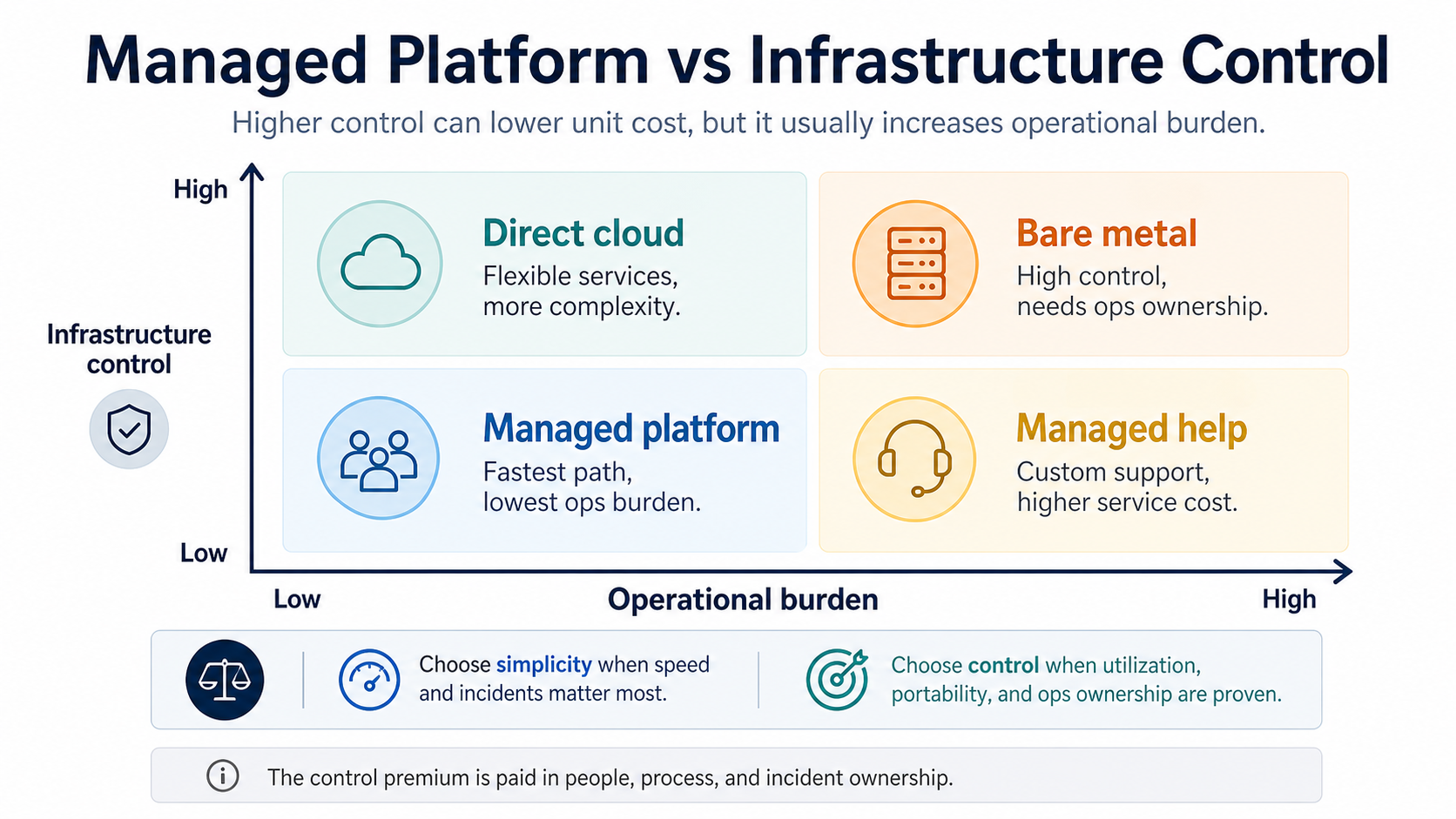
Simple version
Short version
A managed platform is better when it removes operational work the team should not own; direct infrastructure is better when control creates enough performance, cost, or compliance value to justify the burden.
Pay for control only when the team can use it well.RunPlacement quiz
Pressure-test this workload
Pay for control only when the team can use it well.
Uses workload type, budget, GPU need, data movement, priority, and ops tolerance.Example scenarios
Managed platform can win if deployment speed and incident reduction matter more than unit cost.
Direct cloud or bare metal can win if platform limits block required control.
Managed inference can win if batching and autoscaling reduce idle GPU cost enough.
Decision Table
| Option | Best use | Risk |
|---|---|---|
| Managed platform | Deployment speed, reliability defaults, lower ops burden | Limits, premium, portability risk |
| Direct cloud | Flexible services, enterprise controls, custom architecture | Complexity and surprise bill risk |
| Bare metal | Low unit cost at high utilization | Operations and capacity planning |
| Specialized platform | Domain-specific performance or workflow | Integration and lock-in risk |
Quality guide
How to use this framework
RunPlacement pages use public provider documentation, source-linked pricing pages where relevant, estimate-labeled examples, and practical decision frameworks. Estimates are directional and should be verified against provider pricing pages before buying or migrating.
Who this is for
- Teams comparing managed platforms, direct cloud, bare metal, or managed infrastructure help.
- Founders deciding whether simplicity is worth a higher visible price.
- Engineers trying to make operational burden explicit.
How to use it
- Decide whether speed, incident reduction, and lower operational burden matter more than infrastructure control.
- Use the matrix to identify whether the team is paying in platform markup or engineering time.
- Revisit the decision when utilization, portability, or ops ownership changes.
Common mistakes
- Calling managed platforms expensive without pricing deployment, monitoring, incident response, and rollback work.
- Choosing self-managed infrastructure when nobody owns operations.
- Treating control as free because the monthly provider bill is lower.
When it does not apply
- Use compliance review when the platform cannot meet a requirement.
- Use architecture review when provider-specific services dominate.
- Use capacity planning when the workload is already highly utilized and stable.
Worked examples and scenarios
Small product team
A managed platform can win when deployment speed and fewer incidents are more valuable than the lowest compute line item.
Steady high-utilization service
Direct cloud or bare metal can win when utilization is predictable and the team already owns operations.
Custom support need
Managed help can fit when the workload needs custom infrastructure but the team cannot carry every incident path alone.
Related decisions
Apply the framework
Use these long-tail decision pages when a specific cost driver or provider choice is already visible.
A managed platform can be the better placement when engineering focus and reliability matter more than infrastructure control. Direct cloud can be better when the team needs flexibility, deep customization, or lower unit cost at scale.
AWS bill shockCloud Cost Tools for Startups: What to Use Before Hiring FinOpsCommercial investigationStartups usually need three layers: native billing visibility, lightweight alerting or cleanup, and a decision worksheet for workload placement when the bill changes the infrastructure strategy.
GPU pricingGPU Cloud Idle Cost: How to Price Wasted Accelerator TimeCost estimationGPU cloud idle cost is the gap between paid accelerator time and useful workload progress. It matters most for training retries, batch queues, and inference fleets with low baseline utilization.
Related resources
Turn the framework into a worksheet
These checklists make the concept easier to share and apply.
A practical worksheet and decision map for deciding where a workload should run before provider choice hardens.
Cloud migrationCloud Exit Cost ChecklistChecklist / 7 sections / source-linkedA checklist and payback worksheet for pricing the real cost of leaving AWS, GCP, or Azure before migration starts.
FAQ
Is a managed platform always more expensive?
A managed platform is not always more expensive once engineering time, incidents, scaling, monitoring, reliability work, and maintenance are included. The fair comparison is platform premium versus operations avoided, limits accepted, and portability risk. Direct infrastructure only wins when the team can use the extra control well.
When should a team keep infrastructure control?
A team should keep infrastructure control when the workload needs deep customization, unusual networking, strict runtime behavior, compliance constraints, or scale economics a platform cannot provide. The control must create enough value to justify owning deployment, monitoring, reliability, upgrades, and incident response.
What is the control premium?
The control premium is the extra infrastructure work a team accepts in exchange for deeper control over runtime, network, scaling, and cost model. It includes engineering time, reliability ownership, incident response, security maintenance, and capacity planning that a managed platform might otherwise absorb.
Sources
RunPlacement quiz
Pressure-test this workload
Pay for control only when the team can use it well.
Uses workload type, budget, GPU need, data movement, priority, and ops tolerance.