Workload placement
Workload Placement Worksheet
Short answer: Use this when the team is choosing between default cloud, smaller cloud, GPU cloud, bare metal, or managed infrastructure.
- This is a decision checklist, not a final price quote.
- Verify final numbers against provider pricing pages and your own bill or quote.
Placement pass
Use This Before Comparing Providers
Most placement debates get easier when the team chooses the infrastructure category before picking brands.
Copy the planning block
Fill in workload shape, dominant cost driver, data gravity, GPU need, and operations tolerance.
Choose candidate categories
Compare default cloud, specialized GPU cloud, smaller cloud, bare metal, managed platform, and hybrid placement.
List missing evidence
Name the logs, bills, quotes, or ownership decisions needed before asking providers for numbers.
Filled example
Example: Category Choice
Hypothetical placement framing, not a provider recommendation.
| Input | Hypothetical value |
|---|---|
| Workload shape | Batch inference job with flexible latency. |
| Dominant constraint | Useful GPU-hours and data movement. |
| Likely categories | Specialized GPU cloud or hybrid placement before exact provider comparison. |
What it flags: The useful output is a category short list and missing evidence, not a premature provider pick.
Use this when
- The team is comparing categories, not just providers.
- The workload could plausibly run on default cloud, GPU cloud, smaller cloud, bare metal, or a managed platform.
- Cost, speed, simplicity, GPU availability, and operational burden are pulling the decision in different directions.
Not for
- Final vendor selection without real quotes.
- Replacing security, compliance, or architecture review.
- Workloads where the placement is already dictated by regulation or an existing platform contract.
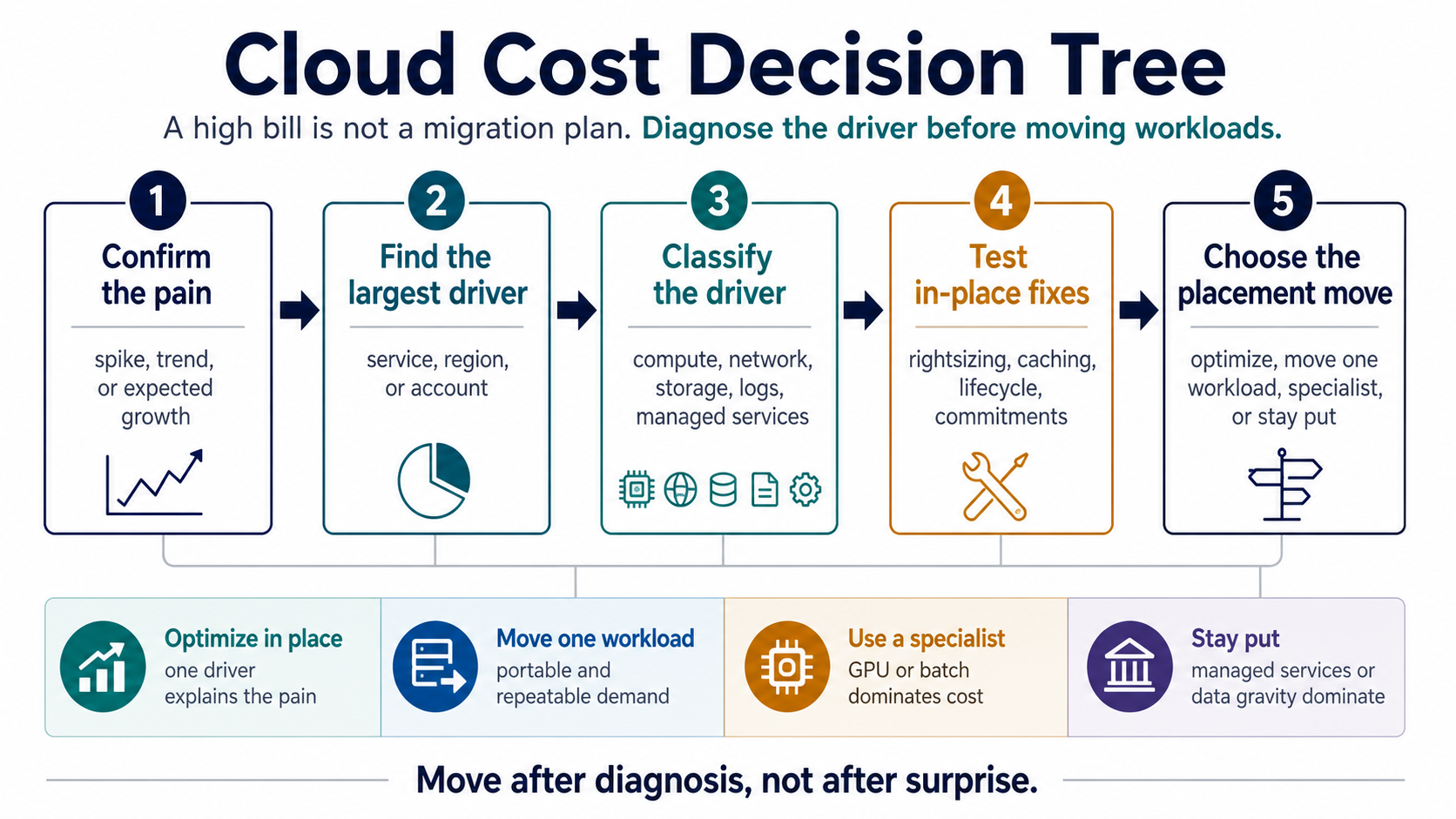
Placement decision map
Provider choice should come after workload shape.
The right category usually appears once the workload’s constraints are visible.
Batch, web, training, inference, data pipeline, or steady service.
Cheap, fast, simple, available capacity, or low operational burden.
GPU need, data movement, latency, compliance, and persistence.
Default cloud, GPU cloud, smaller cloud, bare metal, or managed platform.
Worksheet Fields
Use this as the working version before copying the decision into a doc, ticket, or vendor email.
| Field | Capture | Why it matters |
|---|---|---|
| Workload shape | Training, inference, batch, web app, data pipeline, steady service, experiment. | Defines what success looks like. |
| Dominant constraint | Cheaper, faster, simpler, available capacity, low ops, compliance, latency. | Prevents optimizing for the wrong thing. |
| Hidden gravity | Data movement, GPU need, persistence, region, managed services, team skill. | Finds what makes the obvious answer fragile. |
| Placement category | Default cloud, specialized GPU cloud, smaller cloud, bare metal, managed platform. | Creates a shortlist before vendor shopping. |
Planning-ready
Copy Into A Planning Doc
Use this block when the team is comparing infrastructure categories before picking providers.
Workload placement planning block

Workload name:
Workload shape: training / inference / batch / web app / data pipeline / steady service / experiment
Current placement:
Candidate placement categories: default cloud / specialized GPU cloud / smaller cloud / bare metal / managed platform / hybrid
Dominant cost driver:
GPU or accelerator need:
Data gravity and movement:
Latency requirement:
Operational tolerance:
Reliability or incident owner:
Compliance, privacy, or procurement constraints:
Commitment risk:
Main risk of staying put:
Main risk of moving:
Candidate next step:
Evidence still missing:

Decision rule: choose the infrastructure category that fits workload shape, cost driver, data movement, GPU need, and operations tolerance before comparing providers.
AI prompt
Prompt To Classify Workload Placement
Paste the planning block into your AI tool when the team is arguing across categories instead of comparing exact providers.
You are helping me classify workload placement. Do not choose a provider by brand and do not assume current provider pricing. Recommend an infrastructure category before provider comparison.

Here are the workload details:
[Paste the planning block here]

Please:
1. Classify the workload shape and dominant constraint.
2. Compare default cloud, specialized GPU cloud, smaller cloud, bare metal, managed platform, and hybrid placement as categories.
3. Identify hidden costs: data movement, idle capacity, operations burden, reliability, support, and migration risk.
4. Recommend the most plausible placement category for now and explain what would change the recommendation.
5. List missing evidence to collect before requesting provider quotes.
6. Avoid benchmark, provider-ranking, current-pricing, legal, or compliance claims unless I supplied source data.
Short Answer
- The best placement is workload-specific.
- A cheap option can become expensive if it adds ops load, data transfer, or idle capacity.
- A familiar provider can become expensive when the workload only needs a simpler placement category.
Inputs To Capture
- Workload type: batch jobs, inference, training, web app, or data pipeline.
- Runtime pattern: steady, bursty, batch, experimental, or always-on.
- Current provider and what feels wrong.
- Monthly budget range and whether the pain is recurring or one-off.
- GPU need, GPU utilization expectation, and capacity sensitivity.
- Data movement volume, region needs, and latency sensitivity.
- Ops tolerance, internal expertise, and incident expectations.
Placement Decision Table
- Default cloud: best when managed services, compliance, reliability, or team familiarity matter most.
- Specialized GPU cloud: best when GPU availability and useful GPU-hours dominate the decision.
- Smaller cloud: best when the workload is simple, steady, and overpaying for default-cloud breadth.
- Bare metal: best when utilization is high, workload is stable, and the team can operate hardware-like infrastructure.
- Managed platform or agency help: best when simplicity and low ops burden matter more than lowest unit cost.
Rough Math
- Placement fit = recurring cost + hidden cost + operational cost + risk cost.
- Ops-adjusted cost = infrastructure bill + estimated engineer time + incident risk.
- Utilization break-even = fixed monthly cost / expected useful workload hours.
- The worksheet is directional; use provider quotes and observed bills for final pricing.
Questions To Answer
- What must be true for this workload to be considered successful?
- Is the pain cost, speed, availability, simplicity, or uncertainty?
- Does the workload need provider-specific services or just compute?
- How much data moves in and out of the placement?
- Can the team operate the cheaper option without creating a new failure mode?
- Would a partial move solve the problem without a full migration?
Red Flags
- The decision starts with a provider brand instead of workload shape.
- The cheapest option requires ops work nobody owns.
- The team cannot explain data movement.
- The workload is experimental but the infrastructure choice creates long commitments.
- The bill is high but no one has separated compute, storage, networking, and managed services.
When To Use The Quiz
- Use the RunPlacement quiz when the team is arguing across categories instead of comparing exact providers.
- The quiz turns the worksheet inputs into a rough recommended category.
FAQ
What does workload placement mean?
Workload placement means choosing the infrastructure category that fits a workload before choosing a specific provider. It compares cost driver, data path, performance needs, operational tolerance, and commitment risk. The answer might be default cloud, GPU cloud, smaller cloud, bare metal, managed platform, or no move.
Why not just use AWS, GCP, or Azure by default?
AWS, GCP, or Azure can be the right default when managed services, reliability, compliance, procurement, or team familiarity matter. They can be wasteful when a simple, portable, specialized, or steady workload pays for breadth it does not use. The worksheet tests that fit before provider comparison.
When is bare metal worth considering?
Bare metal is worth considering when utilization is high, demand is steady, the workload is portable, and the team can handle operations. It is less attractive for bursty, experimental, or managed-service-heavy workloads where flexibility, support, and lower operational burden are more valuable.
Sources
RunPlacement quiz
Pressure-test this workload
Pick placement from workload shape, cost sensitivity, GPU need, data movement, and ops tolerance; not from provider familiarity alone.
Uses workload type, budget, GPU need, data movement, priority, and ops tolerance.