Cloud migration / RunPlacement framework
Cloud Exit Payback Framework
Direct answer: Cloud exit is financially serious only when steady savings repay migration work, data movement, service replacement, downtime risk, rollback planning, and new operations inside an acceptable window.
- Move only when the payback window survives realistic migration and operations costs.
- Use provider pricing pages and your own bill or quote before making a purchase or migration decision.
Definition
cloud exit payback
Cloud exit payback is the number of months required for recurring savings from a migration or partial move to repay the cost and risk of leaving the current placement.
Payback months = exit project cost / monthly repeatable savings.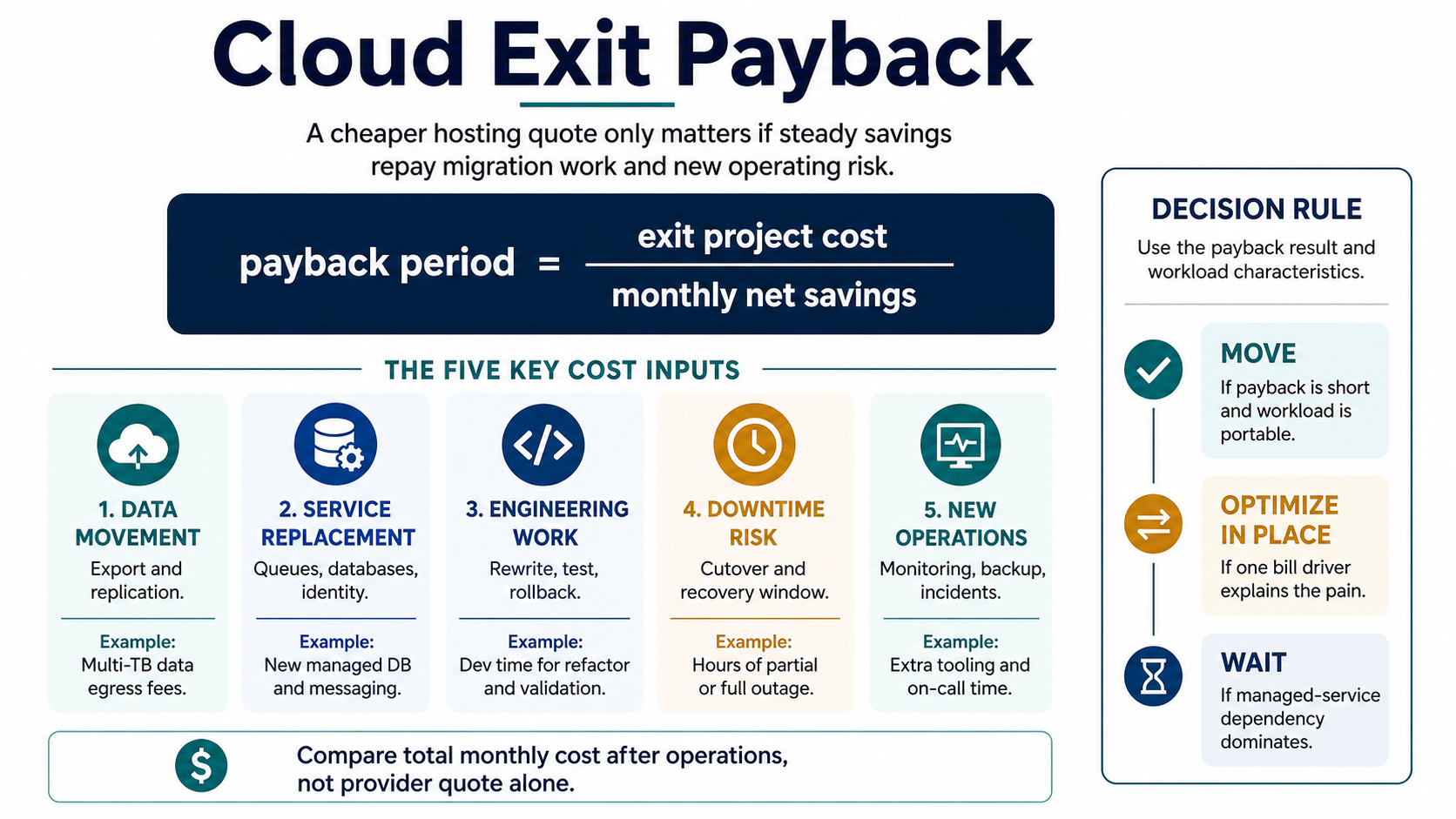
Simple version
Short version
Cloud exit is financially serious only when steady savings repay migration work, data movement, service replacement, downtime risk, rollback planning, and new operations inside an acceptable window.
Move only when the payback window survives realistic migration and operations costs.RunPlacement quiz
Pressure-test this workload
Move only when the payback window survives realistic migration and operations costs.
Uses workload type, budget, GPU need, data movement, priority, and ops tolerance.Example scenarios
Keep data-heavy services in the major cloud but move repeatable GPU jobs if data movement is controlled.
Dedicated capacity can pay back when utilization is high and operations are owned.
A lower hosting quote can fail if provider-specific services must be rebuilt.
Decision Table
| Option | Best use | Risk |
|---|---|---|
| Current baseline | Steady monthly cost after removing one-off spikes | The fair comparison starting point |
| Target baseline | Destination cost with equivalent reliability and support | Prevents fake savings |
| Exit project cost | Data export, rewrite, test, downtime, rollback, training | The cost to repay |
| Payback window | Months until repeatable savings repay the move | The migration go/no-go signal |
Quality guide
How to use this framework
RunPlacement pages use public provider documentation, source-linked pricing pages where relevant, estimate-labeled examples, and practical decision frameworks. Estimates are directional and should be verified against provider pricing pages before buying or migrating.
Who this is for
- Teams considering leaving AWS, GCP, or Azure for cheaper infrastructure.
- Founders comparing a lower hosting quote against migration work.
- Operators who need to explain why cloud exit is a payback question, not just a price quote.
How to use it
- Estimate monthly net savings after the new operating model, not just provider quote difference.
- Price data movement, service replacement, testing, rollback, and downtime risk before calculating payback.
- Prefer partial moves when one workload can move without dragging the whole system across providers.
Common mistakes
- Ignoring engineer time because the target provider quote is lower.
- Leaving managed-service replacements out of the exit project cost.
- Treating a one-month bill spike as proof that full migration will pay back.
When it does not apply
- Use financial modeling for audited business cases.
- Use provider architects for exact migration designs.
- Do not use this framework when compliance, data residency, or procurement blocks the move regardless of payback.
Worked examples and scenarios
Partial GPU move
A GPU batch workload may move while databases and user-facing services stay in the major cloud. That can capture savings without rebuilding the whole platform.
Service replacement trap
A lower compute quote can fail when queues, identity, backups, observability, and incident ownership must be rebuilt from scratch.
Rollback window
If the team cannot describe how to reverse the migration, the exit project cost is not complete. Rollback planning is part of payback math.
Related decisions
Apply the framework
Use these long-tail decision pages when a specific cost driver or provider choice is already visible.
Cloud egress is only one part of exit cost. A serious migration estimate also prices data export, recurring transfer, storage retrieval, rewrites, testing, downtime, rollback, and new operations.
Cloud migrationBare Metal vs Cloud Break-Even: When Dedicated Servers WinCommercial comparisonBare metal can win when a workload is steady, portable, highly utilized, and operationally owned. Cloud usually wins when flexibility, managed services, or variable demand matter more than unit cost.
GPU pricingCoreWeave vs AWS GPU Cloud: When Specialized GPU Cloud FitsProvider comparisonCoreWeave vs AWS is a category decision first. Specialized GPU cloud can fit GPU-heavy work, while AWS can fit teams that need broader cloud services, existing controls, or tighter integration with current infrastructure.
Related resources
Turn the framework into a worksheet
These checklists make the concept easier to share and apply.
A source-backed index of the assumptions to collect before estimating cloud exit payback, partial migration, or workload re-placement.
Cloud migrationCloud Exit Cost ChecklistChecklist / 7 sections / source-linkedA checklist and payback worksheet for pricing the real cost of leaving AWS, GCP, or Azure before migration starts.
Workload placementWorkload Placement WorksheetChecklist / 7 sections / source-linkedA practical worksheet and decision map for deciding where a workload should run before provider choice hardens.
FAQ
What is a good cloud exit payback period?
A good cloud exit payback period is one the team can defend against migration risk, not a universal number. The payback window should include repeatable savings, data movement, engineering time, downtime risk, rollback, replacement services, support, and new operations before lower hosting cost is treated as savings.
What costs belong in exit project cost?
Exit project cost should include data movement, engineering time, testing, downtime risk, rollback, service replacements, monitoring, support, training, and incident ownership. It should also include the work needed to rebuild reliability and operations at the destination, not only transfer fees or a new hosting quote.
Should cloud exit be all-or-nothing?
Cloud exit does not have to be all-or-nothing. Partial migration can move a GPU, batch, storage-heavy, or unusually expensive workload while leaving tightly coupled services in place. That can reduce risk if the painful cost driver is isolated and the remaining data path still works.
Sources
RunPlacement quiz
Pressure-test this workload
Move only when the payback window survives realistic migration and operations costs.
Uses workload type, budget, GPU need, data movement, priority, and ops tolerance.